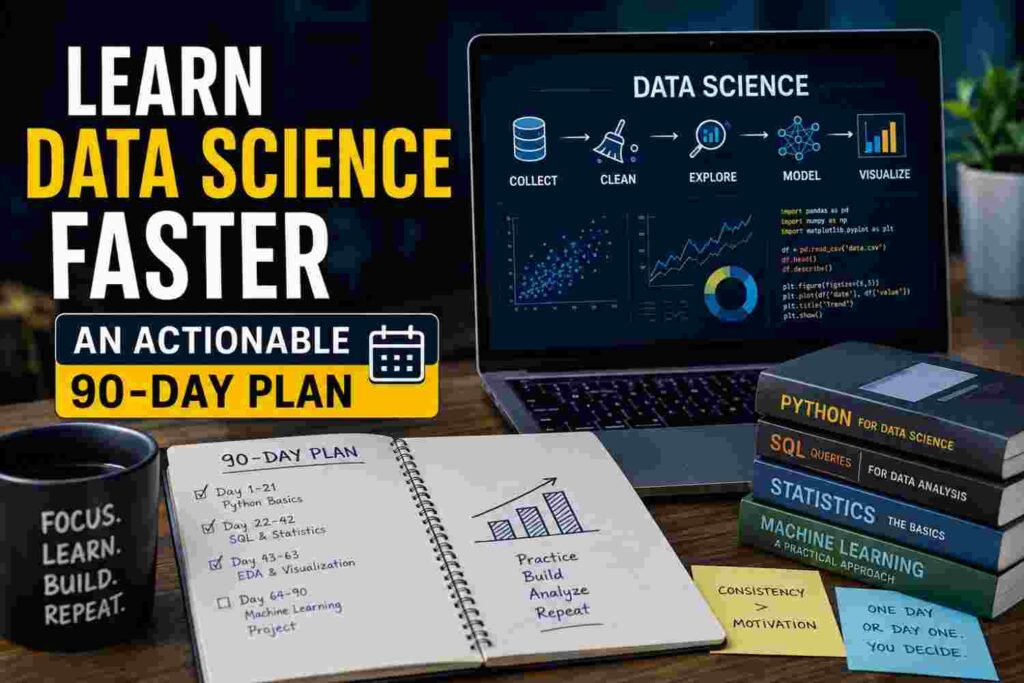
Most people quit learning data science not because it’s too hard, but because they never had a plan. They jump between YouTube videos, half-finished courses, and random blog posts, and after six months they still can’t build anything on their own. Ninety days, with the right structure, is enough time to change that.
This guide breaks data science down into a week-by-week plan you can actually follow, even if you have a full-time job. No wasted time on theory you won’t use. No 40-hour courses that teach you calculus before you’ve written a single line of code.
Why Most People Learn Data Science So Slowly
Before jumping into the plan, it helps to know what actually slows people down. It’s rarely a lack of intelligence.
- Course-hopping. Starting a new course every time the last one feels boring.
- Learning tools out of order. Trying to learn deep learning before understanding basic statistics.
- No real projects. Watching tutorials without ever touching a messy, real dataset.
- No accountability. Studying alone with no deadline, so “someday” becomes never.
The 90-day plan below fixes all four problems by giving you a fixed sequence, a project at every stage, and weekly checkpoints.
The Mindset Shift: Build First, Understand Later
Traditional education teaches theory first, then application. That’s backwards for data science. You’ll learn faster by writing code that solves a real problem, then going back to understand why it worked.
For example, instead of spending a week studying the math behind linear regression, spend two hours building one with a housing price dataset in Python. Once you see it predict prices, Learn Data the math behind it suddenly makes sense because you have something to attach it to.
Days 1–30: Foundations You Can’t Skip
The first month is about building a base in three areas: Python, Learn Data Science Faster An Actionable 90-Day Plan basic statistics, and data handling. Don’t try to master any of these—just get functional.
Week 1: Python Basics
Focus only on what data scientists actually use daily:
- Variables, loops, and functions
- Lists, dictionaries, and basic data structures
- Reading and writing files
- Using Jupyter Notebook or Google Colab
Skip object-oriented programming for now. You don’t need it yet, and trying to learn it early just slows you down.
Week 2: Data Handling with Pandas and NumPy
This is where data science actually starts feeling real. Pandas lets you load, Learn Data clean, and explore datasets in minutes.
Practice with a public dataset—something like the Titanic passenger data or a retail sales dataset from Kaggle. Try to answer simple questions:
- What percentage of passengers survived?
- Which product category had the highest sales last quarter?
- Are there missing values, and how should you handle them?
Week 3: Statistics That Actually Matter
You need enough statistics to understand your data, not to pass a graduate exam. Focus on:
- Mean, median, mode, and standard deviation
- Correlation vs. causation
- Probability basics
- Distributions (normal, skewed)
- Hypothesis testing basics (p-values, confidence intervals)
A good trick: whenever you learn a new statistical concept, Learn Data immediately calculate it using Pandas on a real dataset instead of a textbook example.
Week 4: Data Visualization
Numbers alone don’t tell stories. Charts do. Learn Matplotlib and Seaborn well enough to create:
- Bar charts and histograms
- Scatter plots to show relationships
- Line charts for trends over time
Project checkpoint (Day 30): Pick one dataset and produce a short analysis report with at least five charts and three written insights. This becomes the first piece in your portfolio.
Days 31–60: Machine Learning and Real Projects
Month two is where things get exciting. You’ll move from analyzing data to making predictions with it.
Week 5–6: Core Machine Learning Concepts
Using Scikit-learn, learn these models in order:
- Linear regression (predicting a number)
- Logistic regression (predicting a category)
- Decision trees and random forests
- K-means clustering (finding groups in data without labels)
For each model, don’t just run the code—learn what problem it solves. A model that predicts house prices is solving a different type of problem than one that predicts whether a customer will cancel a subscription.
Week 7: Model Evaluation
A model that looks accurate can still be useless. Learn how to check your work:
- Train/test split and why it matters
- Accuracy, precision, recall, and F1 score
- Confusion matrices
- Overfitting and how to spot it
This is a step beginners often skip, and it’s exactly why so many portfolio projects look impressive but fall apart under questioning.
Week 8: Your First End-to-End Project
Pick a real problem and take it Learn Data from raw data to a working model. A strong beginner-friendly example: predicting customer churn for a telecom company using a public dataset.
Your project should include:
- Data cleaning (handling missing values, fixing formats)
- Exploratory analysis with charts
- At least two models compared against each other
- A short written summary explaining which model performed best and why
Project checkpoint (Day 60): Publish this project on GitHub with a clear README file explaining your process, like you’re showing it to a hiring manager.
Days 61–90: Specialize and Build a Portfolio That Gets Noticed
By month three, you know enough to start narrowing your focus and building work that actually gets attention.
Week 9: Pick a Specialization
Data science is broad. Choosing a direction speeds up your learning and makes your portfolio more focused. Common paths:
- Business analytics — dashboards, reporting, and decision-support tools
- Machine learning engineering — building and deploying predictive models
- Natural language processing — working with text data, like sentiment analysis
- Computer vision — working with images, like object detection
You don’t need to pick forever—just pick for now
Week 10–11: A Specialized Capstone Project
This should be the most polished item in your portfolio. Some real-world project ideas by specialization:
- Business analytics: Build a sales dashboard in Tableau or Power BI using real e-commerce data, Learn Data with filters by region and time period.
- Machine learning: Build a model that predicts loan default risk and deploy it as a simple web app using Streamlit.
- NLP: Analyze thousands of product reviews to classify them as positive, negative, or neutral, Learn Data Science Faster An Actionable 90-Day Plan then visualize trends by month.
- Computer vision: Build an image classifier that sorts photos of plants by species using a small labeled dataset.
Document every decision you make. Interviewers care less about the final accuracy score and more about how you think through problems.
Week 12: Polish and Present
The final week isn’t about learning something new—it’s about making everything you built visible and understandable to others.
- Clean up your GitHub repositories with clear descriptions
- Write one blog post or LinkedIn article explaining your capstone project in plain language
- Update your resume with specific project outcomes (e.g., “Built a churn prediction model with 84% accuracy using customer behavior data”)
- Practice explaining your projects out loud in under two minutes each
Project checkpoint (Day 90): You should have three portfolio projects, Learn Data Science Faster An Actionable 90-Day Plan a GitHub profile that looks active, and the ability to explain your work clearly to a non-technical person.
A Simple Weekly Routine to Stay on Track
Consistency beats intensity. Here’s a routine that works well alongside a full-time job:
- Weekdays: 45–60 minutes of focused learning or coding
- Weekends: 2–3 hours dedicated to project work
- Every Sunday: 15 minutes reviewing what you learned and planning the next week
If you miss a day, don’t try to “catch up” by doubling the next session. Just pick up where the plan left off. Momentum matters more than perfection.
Tools You Actually Need (And Ones You Can Skip)
Use these:
- Python (not R, unless your target job specifically asks for it)
- Jupyter Notebook or Google Colab
- Pandas, NumPy, Matplotlib, Seaborn
- Scikit-learn
- Git and GitHub
Skip these for now:
- Deep learning frameworks like TensorFlow or PyTorch (unless your specialization is computer vision or NLP)
- Big data tools like Spark or Hadoop (rarely needed for beginner or even mid-level roles)
- Advanced math courses before you’ve built anything
Common Mistakes That Slow Down Your Progress
- Watching instead of doing. Tutorials feel productive but rarely build real skill. Type the code yourself, even if you’re copying it at first.
- Perfectionism on early projects. Your first project won’t be great, and that’s fine. Learn Data Science Faster An Actionable 90-Day Plan Ship it and move on.
- Ignoring the business side. A model is only useful if it solves a real problem someone cares about. Always explain the “so what” behind your results.
- Comparing your Day 10 to someone else’s Day 300. Everyone’s timeline looks different depending on their starting point.
Final Thoughts: Your Next 90 Days Start Now
You don’t need a perfect plan or unlimited time to learn data science faster—you need a clear sequence, real projects, and the discipline to show up most days. This 90-day plan gives you that structure. The people who succeed with it aren’t the ones with the highest IQ; they’re the ones who finish what they start, Learn Data Science Faster An Actionable 90-Day Plan one small project at a time.
Pick a dataset today. Open a notebook. Write your first five lines of code. That’s how every data scientist’s journey actually begins.
Frequently Asked Questions
Can I really learn data science in 90 days? You can build a solid, job-ready foundation in 90 days if you study consistently and focus on real projects instead of just watching courses. You won’t know everything, but you’ll know enough to keep learning on the job.
Do I need a math or computer science degree to learn data science? No. Most working data scientists come from varied backgrounds. You need practical statistics and basic Learn Data programming skills, Learn Data Science Faster An Actionable 90-Day Plan not a formal math degree.
Should I learn Python or R first? Python is the better choice for most beginners because it’s used more widely in industry and has a larger, Learn Data more beginner-friendly ecosystem of tools.
How much time per day do I need to follow this plan? Around 45 to 90 minutes on weekdays, with longer sessions on weekends for project work, is enough to complete this plan in 90 days.
What should my first data science project be? Start with a well-known public dataset, like Titanic survival data or a retail sales dataset, and focus on cleaning the data, Learn Data creating a few charts, and writing three clear insights.

