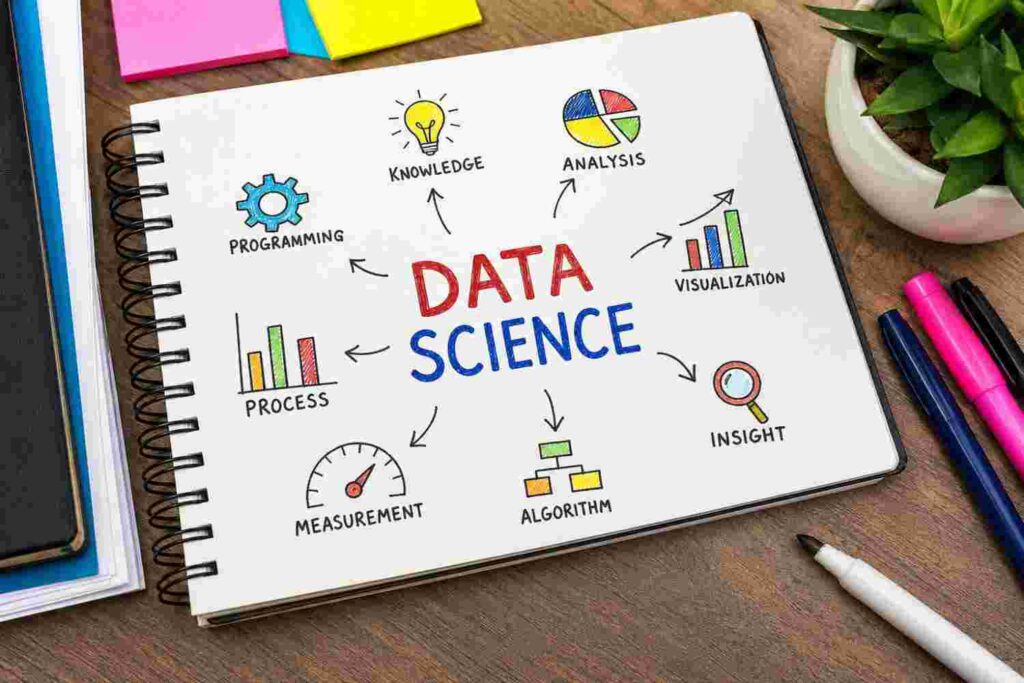
Data science continues to change how businesses, governments, researchers, and everyday services make decisions. From predicting customer needs to improving healthcare research, data science helps turn large amounts of information into useful insights. As artificial intelligence and automation become more common, the skills expected from data professionals are also changing.
Learning data science in 2026 is no longer only about knowing Python or building machine learning models. A successful data scientist needs a wider skill set that includes statistics, data visualization, communication, critical thinking, AI awareness, and responsible data use.
The good news is that you do not need to master everything at once. By building strong foundations and practicing with real-world datasets, you can gradually develop the skills needed for modern data science careers.
In this guide, we explore 10 important data science skills you need to master for 2026, explain why each skill matters, and show how you can use it in practical situations.
1. Python Programming
Python remains one of the most useful programming languages for data science. Its simple syntax makes it suitable for beginners, while its large ecosystem supports advanced data analysis and machine learning work.
Data scientists commonly use Python to clean datasets, analyze information, automate repetitive tasks, and create machine learning models.
Popular Python libraries include:
- Pandas for data manipulation and analysis
- NumPy for numerical computing
- Matplotlib for charts and graphs
- Scikit-learn for machine learning
- PyTorch and TensorFlow for advanced machine learning and deep learning
Why Python Matters in 2026
Modern data teams often work with large and complex datasets. Python can help automate tasks that would take hours to complete manually.
For example, an online store could use Python to analyze thousands of customer transactions and identify products that are often purchased together. A logistics company could use it to study delivery times and find patterns that cause delays.
You do not need to become a software engineer before starting data science. Focus first on variables, functions, loops, data structures, files, and basic object-oriented concepts.
2. Statistics and Probability
Statistics is one of the foundations of data science. Machine learning tools can produce impressive results, but understanding the numbers behind those results is essential.
A data scientist should understand concepts such as:
- Mean, median, and standard deviation
- Probability distributions
- Correlation and covariance
- Sampling
- Hypothesis testing
- Confidence intervals
- Regression
- Statistical significance
Why Statistics Is Still Important
Imagine that a company changes the design of its website and sees higher sales. It may be tempting to assume that the new design caused the improvement. Statistical analysis can help determine whether the change is meaningful or simply the result of normal variation.
Strong statistical knowledge also helps data scientists recognize misleading patterns and avoid making conclusions from weak evidence.
In 2026, automated AI tools can help perform calculations, but professionals still need to understand whether the results make sense.
3. SQL and Database Management
Data is often stored inside databases rather than simple spreadsheets. This makes SQL an essential skill for many data science and analytics jobs.
SQL allows you to retrieve, filter, combine, and summarize information stored in databases.
For example, an online retailer might store customer, product, order, and payment information in separate tables. A data professional could use SQL to determine:
- Which products generate the most revenue
- How many customers returned each month
- Which regions have the highest sales
- How purchasing behavior changes over time
What to Learn
Start with basic SQL commands such as:
SELECTWHEREGROUP BYORDER BYJOIN- Aggregate functions
- Subqueries
- Common table expressions
As your skills improve, learn window functions and query optimization.
Knowing SQL also makes it easier to work with data engineering and business intelligence teams.
4. Data Cleaning and Preparation
Real-world data is rarely perfect. It can contain missing values, duplicate records, inconsistent formats, incorrect entries, and unusual observations.
That makes data cleaning one of the most practical data science skills to develop.
Before building a model, you may need to:
- Remove duplicate records.
- Handle missing information.
- Correct inconsistent formats.
- Detect unusual values.
- Standardize categories.
- Check data types.
- Validate the final dataset.
A Real-World Example
Suppose a company has customer records where the country field contains entries such as “USA,” “U.S.,” “United States,” and “United States of America.”
A computer may treat these as different categories even though they represent the same country. Cleaning the data can prevent inaccurate analysis.
Good data preparation improves the quality of everything that comes afterward. Even an advanced machine learning model can produce poor results when it receives unreliable data.
5. Data Visualization
Numbers can be difficult to understand when presented in large tables. Data visualization turns complex information into charts and visual patterns that people can understand more quickly.
Useful visualization tools include:
- Tableau
- Power BI
- Python visualization libraries
- Interactive dashboard platforms
Choosing the Right Chart
Different questions require different visual formats.
For example:
- Use line charts to show trends over time.
- Use bar charts to compare categories.
- Use scatter plots to explore relationships.
- Use histograms to understand distributions.
- Use maps for geographic patterns.
A good data scientist does not create charts simply because they look attractive. Every visual should help answer a specific question.
For example, a sales manager may understand a declining product category much faster from a clear monthly trend chart than from a spreadsheet containing thousands of rows.
6. Machine Learning
Machine learning is a major part of modern data science. It allows computers to identify patterns in data and make predictions or classifications.
Common machine learning approaches include:
Supervised Learning
The model learns from labeled examples. Applications include:
- Predicting house prices
- Classifying emails
- Forecasting customer demand
- Estimating business risks
Unsupervised Learning
The model looks for patterns without predefined labels. Examples include:
- Customer segmentation
- Grouping similar products
- Detecting unusual behavior
What to Learn First
Beginners should understand concepts such as:
- Training and testing data
- Features and target variables
- Overfitting and underfitting
- Model evaluation
- Cross-validation
- Classification
- Regression
- Clustering
The goal is not to memorize every algorithm. Instead, learn when and why to use different approaches.
7. Artificial Intelligence and Generative AI
AI is becoming an important part of the modern data science workflow. In 2026, data professionals benefit from understanding how AI systems work and how they can be used responsibly.
Generative AI can assist with tasks such as:
- Creating code drafts
- Explaining technical concepts
- Exploring datasets
- Generating documentation
- Summarizing findings
- Developing initial analysis ideas
However, AI output should not automatically be treated as correct.
The Human Skill That Matters
A strong data scientist knows how to verify AI-generated results.
For example, an AI assistant may generate a Python script that appears correct but contains a subtle error. A professional needs enough technical knowledge to test the code and check the output.
Learning basic concepts behind large language models, prompt design, model evaluation, and AI limitations can give data professionals an advantage.
The most valuable approach is to use AI as a productivity tool while keeping human judgment in control.
8. Problem-Solving and Critical Thinking
Technical skills alone do not make someone a great data scientist. You also need to know how to ask the right questions.
A business may give you a request such as, “Can you predict next year’s sales?”
Instead of immediately building a model, a thoughtful data scientist may ask:
- What does “sales” mean in this case?
- Which products are included?
- What historical data is available?
- Are there seasonal patterns?
- Have prices changed?
- What decision will the prediction support?
Why This Skill Matters
Data science exists to solve problems, not simply to produce models.
Critical thinking helps you identify bad assumptions, investigate unusual results, and determine whether a model actually solves the original business problem.
This skill becomes even more valuable as automated tools make technical tasks faster.
9. Data Communication and Storytelling
A technically accurate analysis has limited value if nobody understands it.
Data scientists often need to explain their findings to managers, clients, executives, or teams that do not have a technical background.
Good data communication means:
- Explaining complex ideas in simple language
- Focusing on important findings
- Connecting results to business goals
- Using clear charts
- Avoiding unnecessary technical jargon
- Clearly stating limitations
Example
Instead of telling a manager:
“The model achieved a particular evaluation score after feature engineering.”
You could explain:
“The model can identify customers who are more likely to leave, which gives the support team an opportunity to contact them earlier.”
The second explanation connects technical work to a practical outcome.
10. Data Ethics, Privacy, and Responsible AI
As organizations collect more information, responsible data use becomes increasingly important.
Data professionals may work with customer behavior, financial information, location data, or other sensitive records. They need to understand privacy, security, fairness, and responsible model development.
Important areas include:
- Protecting personal information
- Understanding data permissions
- Reducing bias
- Checking model fairness
- Explaining important decisions
- Using data only for appropriate purposes
Why Responsible Data Science Matters
A model can be technically accurate and still create problems if the underlying data is biased or used incorrectly.
For example, if historical data reflects unfair decisions, a machine learning system trained on that data may reproduce those patterns.
Responsible data science means thinking about the impact of your work, not just its accuracy.
How to Build These Data Science Skills in 2026
Trying to learn all 10 skills at the same time can feel overwhelming. A structured learning path is more effective.
Start With the Foundations
Begin with:
- Python
- Statistics
- SQL
- Data cleaning
- Data visualization
Once these skills are comfortable, move toward machine learning and AI.
Practice With Real Projects
Projects help turn theoretical knowledge into practical ability.
You could build projects such as:
- A customer sales dashboard
- A house price prediction model
- A movie recommendation system
- A customer segmentation analysis
- A simple sales forecasting project
- A dataset quality checker
Choose projects that answer real questions rather than projects designed only to demonstrate code.
Build a Data Science Portfolio
A portfolio can show employers what you can actually do.
For each project, explain:
- The problem
- The dataset
- Your approach
- The tools you used
- Key findings
- Limitations
- Possible improvements
A small collection of well-explained projects can be more useful than dozens of unfinished exercises.
Common Mistakes When Learning Data Science
Many beginners focus too heavily on advanced algorithms before learning the basics.
Avoid these common mistakes:
- Trying to learn every programming language
- Ignoring statistics
- Skipping SQL
- Using machine learning when simple analysis is enough
- Copying code without understanding it
- Building projects without explaining the problem
- Trusting AI-generated answers without checking them
- Creating attractive charts that do not answer useful questions
A strong foundation will make advanced topics much easier to understand.
Final Thoughts
The most valuable data science skills for 2026 combine technical knowledge with human judgment. Python, SQL, statistics, data cleaning, visualization, and machine learning provide the technical foundation. AI knowledge, critical thinking, communication, and responsible data practices help professionals turn that knowledge into meaningful results.
You do not need to become an expert in all 10 areas immediately. Start with the fundamentals, practice regularly, and build projects that solve realistic problems. As your experience grows, gradually add machine learning, generative AI, advanced analytics, and responsible AI practices to your skill set.
The future of data science will likely belong to professionals who can do more than build models. They will be able to understand data, question results, communicate insights, use AI wisely, and connect technical work to real-world decisions.
Frequently Asked Questions
1. What are the most important data science skills for 2026?
Python, SQL, statistics, data cleaning, visualization, machine learning, AI knowledge, critical thinking, communication, and responsible data practices are among the most useful skills.
2. Is Python necessary for learning data science?
Python is not the only option, but it is one of the most useful languages for data science because of its libraries, learning resources, and broad industry use.
3. Can beginners learn data science in 2026?
Yes. Beginners can start with basic Python, statistics, SQL, and data analysis before moving into machine learning and AI.
4. How can I practice data science skills?
Work with real datasets and create projects that answer practical questions. Build dashboards, analyze trends, clean messy datasets, and create simple prediction models.
5. Is AI replacing data scientists?
AI can automate parts of data analysis and coding, but professionals are still needed to define problems, evaluate results, understand context, communicate findings, and make responsible decision

