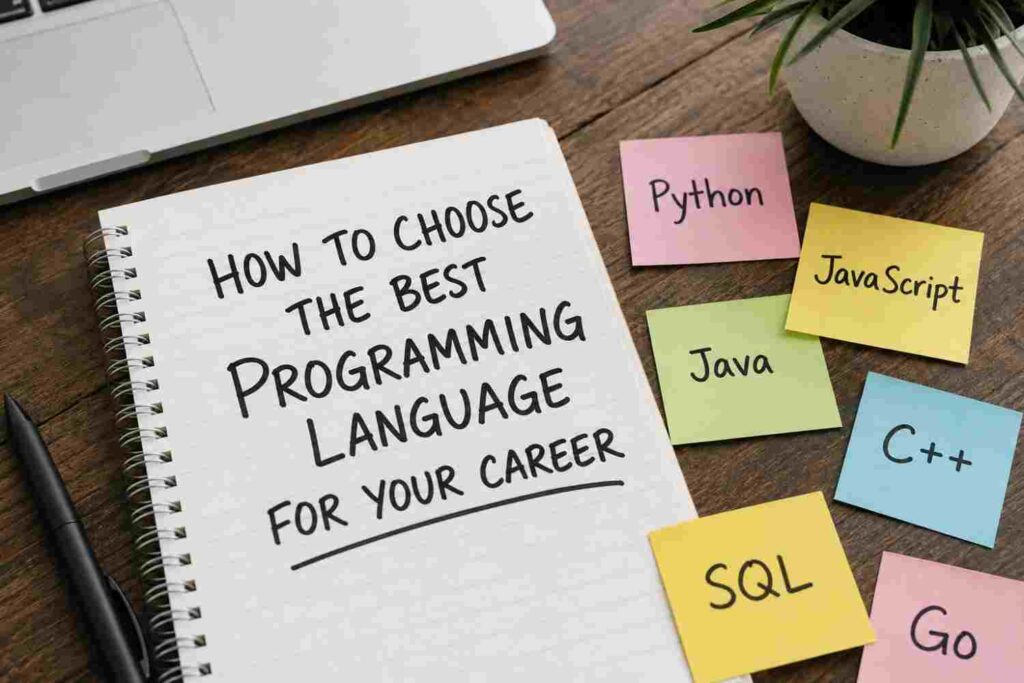
Choosing your first programming language can feel like choosing a career path before you even know where the roads lead. Python, JavaScript, Java, C#, C++, Go, and many other languages can all lead to successful careers—but they are designed for different kinds of work.
The best programming language is not necessarily the one with the most hype, the shortest syntax, or the highest number of tutorials. It is the language that matches your career goal, the type of software you want to build, and the skills you plan to develop next.
This guide explains how to choose a programming language based on real career paths, learning difficulty, project types, job opportunities, and long-term usefulness.
What Makes a Programming Language “Best” for a Career?
There is no universal winner. A language that is excellent for data analysis may be a poor choice for developing a high-performance game engine.
Before choosing a language, consider five factors:
- Career goal: What type of developer do you want to become?
- Learning curve: How quickly can you understand the fundamentals?
- Industry use: Is the language commonly used in your target field?
- Project opportunities: Can you build useful projects with it?
- Long-term value: Will learning it help you develop transferable programming skills?
For example, someone interested in data science may benefit greatly from Python, while someone targeting interactive websites may want to prioritize JavaScript or TypeScript.
Your first language is important, but it does not permanently lock you into one technology. Once you understand programming fundamentals, learning another language becomes much easier.
Start With Your Career Goal
The smartest way to choose a programming language is to start with the destination rather than the tool.
Ask yourself:
“What do I want to build or do with programming?”
Your answer can narrow the choices dramatically.
Web Development
If you want to build websites and web applications, JavaScript is one of the most important languages to learn because it runs directly in web browsers.
You may eventually work with technologies such as:
- JavaScript
- TypeScript
- HTML and CSS
- React
- Node.js
- Next.js
For example, an online store might use JavaScript-based technologies for interactive product pages, shopping carts, account features, and other browser experiences.
If you enjoy creating things people can interact with immediately, web development can be a rewarding starting point.
Data Science and Artificial Intelligence
Python is a particularly strong choice for people interested in data science, machine learning, automation, and artificial intelligence.
Its ecosystem includes tools such as:
- Pandas for data analysis
- NumPy for numerical computing
- Scikit-learn for machine learning
- PyTorch for deep learning
- Matplotlib for visualization
Imagine analyzing millions of customer transactions to identify purchasing patterns. Python can be used to clean the data, explore trends, train models, and create visual reports.
If your career goal involves working heavily with data or AI, Python is a practical starting point.
Mobile App Development
Mobile development requires a different decision because the target platform matters.
For Android development, Kotlin is an important language to consider. For Apple’s platforms, Swift is a natural choice.
You may want to choose based on the devices you want to develop for:
- Android: Kotlin
- iPhone and iPad: Swift
- Cross-platform applications: Languages and frameworks such as Dart with Flutter can be considered
For example, if your goal is to build an Android budgeting app, learning Kotlin gives you a direct path toward Android development concepts and tools.
Game Development
Game development can involve several languages depending on the engine, platform, and type of game.
C# is widely associated with Unity-based development, while C++ is important in many performance-focused game technologies and engines.
Game development also teaches useful programming concepts such as:
- Object-oriented programming
- Game loops
- Physics
- Memory management
- Performance optimization
- Event systems
If you want to build a small 2D game as a beginner, starting with a practical engine and its primary language may be more useful than immediately learning advanced graphics programming.
Enterprise Software
Large organizations often use established languages for applications that must remain reliable and maintainable for years.
Java and C# are important examples.
Java is widely associated with enterprise applications, backend systems, and large-scale software. C# is strongly connected with the .NET ecosystem and is used across web, desktop, cloud, and business applications.
If your goal is enterprise software development, investigate the technology stacks used by employers in the region and industry where you want to work.
Compare Popular Programming Languages by Career Path
Instead of asking which language is “best,” compare languages according to what you want to accomplish.
| Career Goal | Languages to Consider | Why |
|---|---|---|
| Web development | JavaScript, TypeScript | Strong web ecosystem |
| Data science | Python | Extensive data and ML libraries |
| AI and machine learning | Python, C++ | Python for development; C++ for performance-focused systems |
| Android apps | Kotlin | Designed for modern Android development |
| Apple apps | Swift | Apple’s primary modern development language |
| Game development | C#, C++ | Popular in major game-development ecosystems |
| Enterprise software | Java, C# | Mature ecosystems and business use |
| Systems programming | C, C++, Rust, Go | Performance and low-level control |
| Cloud/backend development | Go, Java, C#, Python | Strong server-side use cases |
| Automation | Python | Simple syntax and broad library support |
This table should be treated as a starting point, not a strict rule. Modern software projects frequently combine multiple languages.
Consider How Difficult the Language Is to Learn
Every programming language has a learning curve, but the type of difficulty varies.
Python is often considered approachable because its syntax is relatively readable. JavaScript can be easy to start with but becomes more complex as you encounter asynchronous programming, browser behavior, frameworks, and larger applications.
C and C++ can introduce more difficult concepts, including memory management and low-level programming.
Rust has strong safety features but can require beginners to understand concepts such as ownership and borrowing.
Choose manageable difficulty, not the easiest language
You should not automatically choose the easiest language.
Instead, choose a language that is challenging enough to teach useful concepts without creating unnecessary barriers.
If you want to become a systems programmer, avoiding C or Rust simply because they are challenging may delay the skills you actually need.
The goal is to choose the right level of difficulty for your target career.
Look at the Job Market Before You Commit
A language can be technically excellent and still be a poor career choice if it has little demand in the market you want to enter.
Before spending months learning a language, investigate current job listings.
Search for positions such as:
- Junior Python Developer
- Front-End Developer
- Backend Developer
- Java Developer
- .NET Developer
- Android Developer
- Data Analyst
- Machine Learning Engineer
Look beyond the programming language itself.
A job posting may mention Python but also require SQL, Git, cloud platforms, APIs, testing, or a specific framework.
Use job descriptions as your learning roadmap
Suppose you review 30 junior backend positions and notice that many request:
- Python
- SQL
- REST APIs
- Git
- Docker
- Cloud fundamentals
That information is more useful than choosing Python simply because someone says it is popular.
You are not only learning a language. You are building a marketable technology stack.
Think About the Ecosystem, Not Just the Language
A programming language is only one part of a developer’s toolkit.
A strong ecosystem gives you access to libraries, frameworks, documentation, communities, development tools, and learning resources.
For example, knowing Python becomes much more powerful when you understand the ecosystem around it. Similarly, JavaScript becomes far more useful when combined with modern web development tools.
Before choosing a language, check:
- Are there mature libraries for your field?
- Is documentation easy to find?
- Are frameworks actively maintained?
- Can you find practical learning resources?
- Are developers using it for real projects?
- Does the ecosystem match your career goal?
A language with a strong ecosystem can reduce the amount of work required to build useful software.
Choose a Language That Helps You Build Projects
Tutorials can teach syntax, but projects teach programming.
Once you understand variables, conditions, loops, functions, and basic data structures, start building something.
For Python, you might create:
- A personal expense tracker
- A file organization tool
- A data analysis dashboard
- A simple API
- A text-processing application
For JavaScript, you could build:
- A task manager
- A weather dashboard
- A product search interface
- A browser-based game
- A responsive portfolio website
The project does not need to be revolutionary.
A small application that you designed, coded, tested, debugged, and improved can teach more than completing dozens of passive tutorials.
Don’t Choose a Language Only Because It Is Trending
Technology trends change quickly.
A language may dominate social media discussions today and become less fashionable later. That does not mean you should ignore emerging technologies, but your career should not depend entirely on trends.
Strong programming fundamentals are more durable.
Focus on learning:
- Variables and data types
- Control flow
- Functions
- Data structures
- Algorithms
- Object-oriented concepts
- Debugging
- Testing
- Version control
- Software design
These concepts transfer between languages.
For example, once you understand loops and functions in Python, learning similar concepts in JavaScript becomes much easier.
Understand Your Learning Style
The best programming language for you should also be one you can practice consistently.
If you learn best by creating visual projects, web development may keep you motivated because you can quickly see changes in a browser.
If you enjoy mathematics, patterns, and analysis, Python-based data projects may be more appealing.
If you enjoy understanding how computers work internally, systems programming may provide the challenge you are looking for.
Motivation matters because becoming a capable developer requires repeated practice.
A theoretically perfect language is not useful if you stop learning after two weeks.
Avoid These Common Mistakes When Choosing a Language
Mistake 1: Trying to Learn Five Languages at Once
Beginners sometimes believe that learning several languages will make them employable faster.
Usually, the opposite happens.
You end up knowing basic syntax in five languages without being able to build a complete application in any of them.
Choose one primary language and become comfortable building projects before adding another.
Mistake 2: Choosing Based Only on Salary
Salary can be useful when comparing career paths, but it should not be the only factor.
Location, experience, industry, company size, specialization, and overall engineering ability can influence compensation.
Choose a field you can realistically see yourself working in for several years.
Mistake 3: Ignoring Supporting Skills
Knowing a programming language alone rarely makes someone a complete developer.
Depending on your career, you may also need:
- Git and GitHub
- SQL
- APIs
- Testing
- Linux
- Cloud platforms
- Databases
- Basic security
- Communication skills
The language is the foundation, not the entire building.
Mistake 4: Staying in Tutorial Mode
Watching programming tutorials can create the feeling that you are making progress even when you are not practicing independently.
After learning a concept, use it.
If you learn functions, write a program that needs functions. If you learn APIs, build something that consumes an API.
A Simple Decision Framework
If you are still unsure, use this five-step process.
Step 1: Pick a target career
Choose one primary direction:
Web development, data science, AI, mobile development, games, enterprise software, cloud/backend, or systems programming.
Step 2: Research real job postings
Look at 20–30 relevant positions and record the languages, tools, and skills that appear repeatedly.
Step 3: Choose one primary language
Pick the language that appears frequently and matches your career goal.
Step 4: Build three projects
Start small, then increase complexity.
Your third project should combine several skills and solve a realistic problem.
Step 5: Add complementary skills
Once your primary language feels comfortable, learn the tools commonly used with it.
This approach prevents you from endlessly comparing programming languages without actually learning one.
Should You Learn More Than One Programming Language?
Yes—but timing matters.
Your first goal should be depth.
After you can comfortably build applications, read documentation, debug errors, and understand core programming concepts, learning a second language can broaden your perspective.
For example:
- Python developer → JavaScript or TypeScript
- JavaScript developer → Python
- Java developer → Kotlin
- C++ developer → Rust
- Data scientist → SQL and a backend language
Learning another language becomes particularly valuable when it exposes you to a different programming style or solves problems your primary language does not handle as well.
Final Thoughts
Choosing the best programming language for your career does not require predicting the future. It requires understanding where you want to go and which technology gives you the most direct path there.
If you want to work with data or AI, Python is a strong starting point. If you want to build interactive websites, JavaScript or TypeScript deserves serious consideration. Mobile developers can focus on Kotlin or Swift, while game and systems developers may find C#, C++, Rust, or related technologies more appropriate.
The most important decision is not the language itself. It is what you do after choosing it.
Pick one language, learn its fundamentals, build real projects, study the tools used by professionals, and review actual job requirements. Then expand your skills as your career direction becomes clearer.
Do not spend six months searching for the perfect language. Spend six months becoming genuinely useful with one.
Frequently Asked Questions
What is the best programming language for beginners?
Python is often a practical starting point because its syntax is relatively readable and its ecosystem supports areas such as automation, web development, data analysis, and AI. However, the best choice depends on your career goal.
Which programming language has the best career opportunities?
There is no single winner worldwide. Python, JavaScript, Java, C#, C++, Go, and other languages can lead to strong careers in different fields. Check job postings in the market where you want to work.
Should I learn Python or JavaScript first?
Choose Python if you are interested in data, AI, automation, or general-purpose programming. Choose JavaScript if your main goal is web development and interactive browser applications.
How many programming languages should I learn?
Start with one. Become comfortable building real projects before adding another. Depth in one language is generally more valuable for a beginner than shallow knowledge of several.
Can I change programming languages later in my career?
Absolutely. Experienced developers frequently learn new languages when changing roles, industries, or technology stacks. Strong fundamentals make switching much easier.

