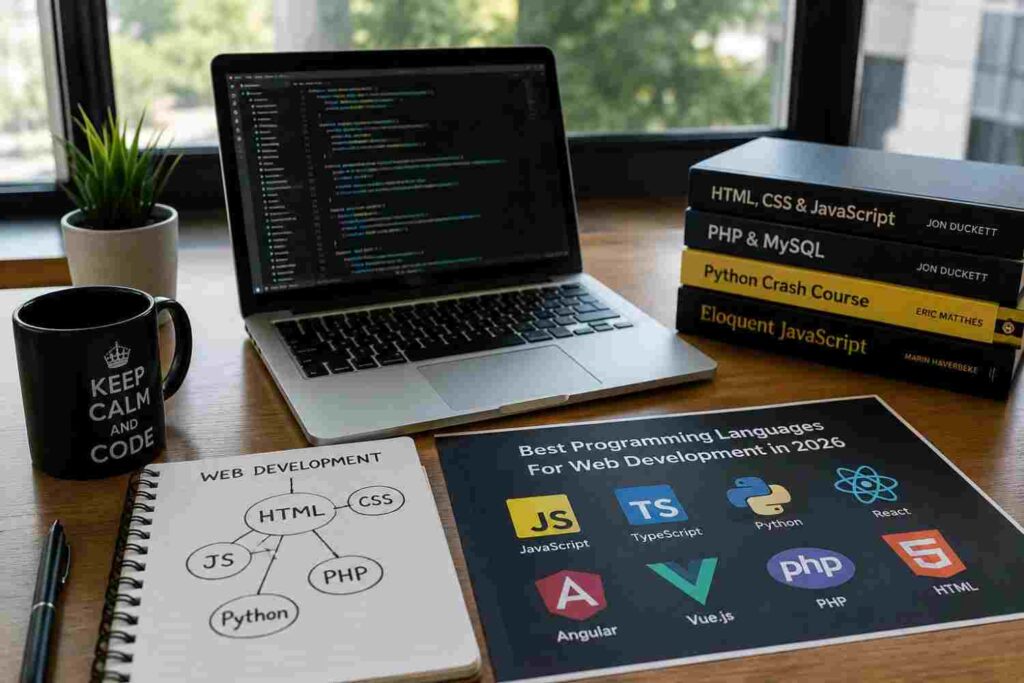
Picking a programming language in 2026 can feel like standing in front of fifty doors, all with different labels, and no idea which one leads where you want to go. New frameworks pop up every year. Old languages get new features. And everyone online seems to have a strong opinion about which one is “the best.”
Here’s the truth: there is no single best language for every project. But there are languages that clearly stand out this year because of their speed, community support, job demand, and how well they solve real problems developers face.
This guide breaks down the top programming languages for web development in 2026, why they matter, and which one might fit your goals — whether you’re building your first website or scaling an app for millions of users.
Why Choosing the Right Language Still Matters in 2026
AI tools can now write code, autocomplete functions, and even debug for you. So does the language you choose even matter anymore?
Yes — more than ever. AI coding assistants are trained on existing languages and their patterns. A language with a strong ecosystem gives AI tools more accurate suggestions, Programming Languages better documentation to pull from, and a larger pool of libraries to plug into your project. A weak or dying language means less support, fewer updates, and a harder time hiring developers who know it.
The right language affects:
- How fast your website loads
- How easily you can find developers to hire
- How well your app scales as your user base grows
- How much long-term maintenance will cost you
With that in mind, let’s look at the languages actually worth your time this year.
1. JavaScript: Still the King of the Web
JavaScript has run the web Programming Languages for over two decades, and 2026 is no different. It’s the only language that runs natively in every browser, which makes it impossible to fully avoid if you’re building anything users interact with.
Why It’s Still Dominant
- Runs on both the front end and back end (thanks to Node.js)
- Massive ecosystem with npm, offering millions of ready-made packages
- Backed by frameworks like React, Vue, and Svelte for building interactive interfaces
- Huge community, meaning answers to almost any problem are just a search away
Real-world example: Companies like Netflix and Airbnb rely heavily on JavaScript across their web platforms because it lets one team manage both the visual interface and the server logic using a shared language.
Where It Falls Short
JavaScript’s flexibility can turn into messiness on large projects. Without discipline, codebases can become hard to maintain — which is exactly why TypeScript exists.
2. TypeScript: JavaScript’s Smarter Sibling
TypeScript adds a type system on top of JavaScript, meaning it catches mistakes before your code even runs. In 2026, most serious web projects use TypeScript instead of plain JavaScript.
Why Developers Love It
- Catches bugs early, during development instead of after launch
- Makes large codebases easier to manage and refactor
- Works seamlessly with popular frameworks like Angular, Next.js, and Nest.js
- Improves collaboration on team projects since types act like built-in documentation
Real-world example: Slack and Microsoft both use TypeScript extensively in their web products because it reduces bugs in complex, fast-moving codebases with many contributors.
If you already know JavaScript, learning TypeScript is a natural next step and one of the smartest career moves you can make this year.
3. Python: The Backend Powerhouse
Python isn’t just for data science and AI anymore — it’s a major player in web development too, Programming Languages especially for backend systems.
Strengths That Keep Python Relevant
- Clean, readable syntax that’s beginner-friendly
- Powerful frameworks like Django and Flask for building web applications quickly
- Excellent for combining web apps with AI or machine learning features
- Strong support for handling data-heavy applications
Real-world example: Instagram runs a massive portion of its backend on Python with Django, proving the language can handle serious scale despite its beginner-friendly reputation.
Where It Can Struggle
Python isn’t the fastest language for handling extremely high traffic loads compared to compiled languages. For most businesses, though, this tradeoff is worth the development speed it offers.
4. Go (Golang): Built for Speed and Scale
Go, created by Google, has become a favorite for backend services that need to handle heavy traffic without slowing down.
Why Go Stands Out
- Compiles into fast, efficient machine code
- Handles concurrent tasks (many things happening at once) extremely well
- Simple syntax that’s easier to learn than many other backend languages
- Great for building microservices and APIs
Real-world example: Companies like Uber and PayPal use Go for backend services that need to process huge numbers of requests reliably and quickly.
Go is a strong pick if you’re building something that needs to scale fast without eating up server resources.
5. Rust: The Rising Star for Performance-Critical Apps
Rust has been climbing developer popularity charts for years, Programming Languages and by 2026 it’s earned a real spot in web development — especially for performance-heavy tools.
Why Rust Is Gaining Ground
- Extremely fast, often rivaling C++ in performance
- Prevents common bugs related to memory management automatically
- Increasingly used for WebAssembly, letting web apps run near-native speed in the browser
- Growing frameworks like Actix and Axum for backend development
Real-world example: Discord rewrote parts of its backend infrastructure in Rust to reduce lag and handle massive real-time messaging loads more efficiently.
Rust has a steeper learning curve than most languages on this list, but it’s worth learning if you care about performance and reliability.
6. PHP: Quietly Still Powering the Internet
PHP doesn’t get much hype anymore, but don’t count it out. It still powers a huge chunk of the internet, Programming Languages including WordPress, which alone runs a large percentage of all websites globally.
Why PHP Still Matters
- Extremely easy to deploy and host, even on cheap servers
- Powers massive platforms like WordPress, Shopify (partially), and Wikipedia
- Modern PHP (especially with Laravel) is fast, clean, and developer-friendly
- Huge existing codebase means constant demand for PHP developers
If you’re building a content-heavy site, an online store, or working within the WordPress ecosystem, PHP remains a practical and profitable choice.
Comparing the Top Languages at a Glance
| Language | Best For | Learning Curve | Job Demand |
|---|---|---|---|
| JavaScript | Interactive websites, full-stack apps | Easy to Moderate | Very High |
| TypeScript | Large-scale, team-based projects | Moderate | Very High |
| Python | Backend apps, AI-integrated sites | Easy | High |
| Go | High-traffic backend systems | Moderate | Growing Fast |
| Rust | Performance-critical apps | Hard | Growing Fast |
| PHP | Content sites, e-commerce | Easy | Steady |
How to Choose the Right Language for Your Project
Instead of chasing trends, ask yourself these questions:
- What am I building? A simple blog needs different tools than a real-time trading platform.
- How much traffic do I expect? High-traffic apps benefit from languages like Go or Rust.
- What’s my timeline? Python and JavaScript let you build and launch faster.
- Will I need to hire a team later? JavaScript and Python have the largest talent pools.
- Do I need AI integration? Python remains the strongest choice for AI-powered features.
There’s no wrong answer here — just the right tool for your specific goal.
Final Thoughts
The web development world in 2026 isn’t about finding one perfect language — it’s about matching the right tool to the right job. JavaScript and TypeScript remain essential for anyone building interactive websites. Programming Languages Python continues to shine for fast development and AI integration. Go and Rust are winning over developers who need serious speed and scalability. And PHP proves that older doesn’t mean outdated.
The best move you can make isn’t memorizing every language on this list — it’s understanding what each one does well, and picking the one that fits your project’s actual needs. Start there, and you’ll be building smarter, faster, and with far less frustration.
Frequently Asked Questions
1. What is the easiest programming language to learn for web development in 2026? Python and JavaScript are generally considered the easiest for beginners. Python has simple, readable syntax, while JavaScript lets you see results instantly in a web browser.
2. Should I learn JavaScript or Python first? If you want to build interactive websites, start with JavaScript. If you’re more interested in backend systems, data, or AI, start with Python. Many developers eventually learn both.
3. Is TypeScript worth learning if I already know JavaScript? Yes. TypeScript helps catch errors early and makes larger projects easier to manage, which is why most professional teams use it over plain JavaScript today.
4. Which language is best for high-traffic websites? Go and Rust are excellent choices for handling heavy traffic efficiently, thanks to their speed and strong performance under load.
5. Is PHP still worth learning in 2026? Yes, especially if you plan to work with WordPress or e-commerce platforms. PHP still powers a massive share of websites and continues to see steady demand.

