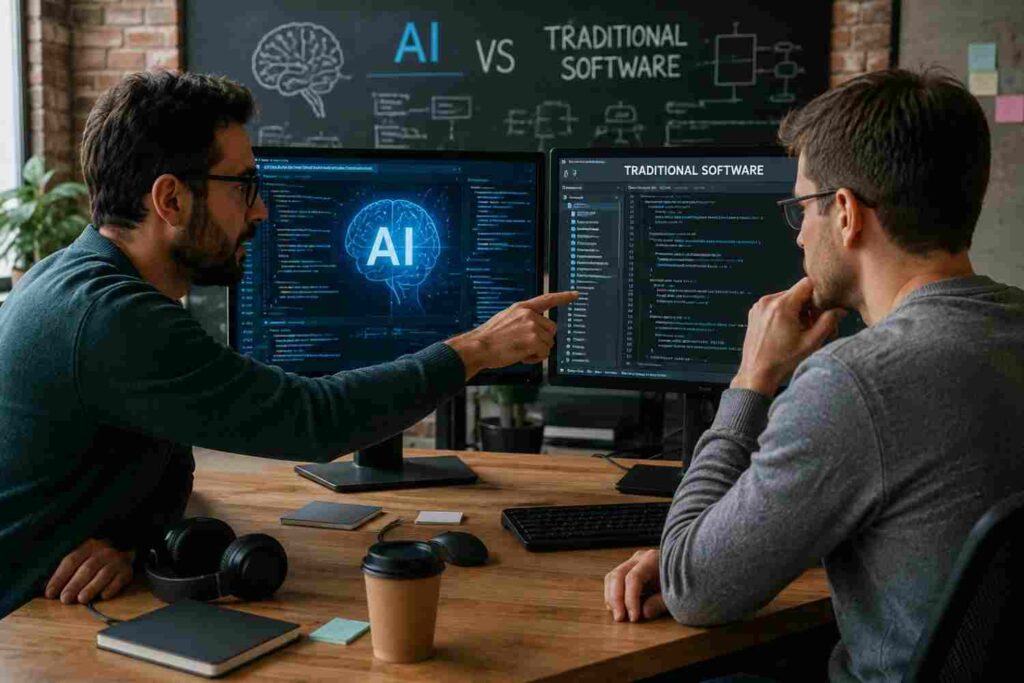
Software used to follow a simple rule: people gave computers instructions, and computers followed them. Today, artificial intelligence is changing that relationship. Instead of relying only on fixed commands and pre-written rules, many modern applications can interpret language, recognize patterns, generate content, and adapt their responses.
This shift is one of the biggest stories in technology news today. From customer-service platforms and coding tools to search engines and office software, AI is moving from a separate feature into the core of many products. But does that mean traditional software is becoming obsolete? Not at all. The real story is more interesting: AI and traditional software are increasingly working together.
What Is Traditional Software?
Traditional software is built around instructions that developers define in advance. A programmer creates rules, logic, workflows, and conditions that tell an application what to do when it receives specific inputs.
A simple banking application, for example, may follow a predictable process:
- A customer enters a payment amount.
- The system checks the account balance.
- It verifies security requirements.
- It approves or rejects the transaction.
- The database records the result.
The same input generally produces the same result when the system’s conditions have not changed.
This predictability is one of traditional software’s greatest strengths. Developers can test defined behaviors, identify bugs, and determine why a particular result occurred.
Traditional software is still essential for areas where accuracy, consistency, and strict rules matter.
Examples include:
- Payroll calculations
- Inventory management
- Accounting systems
- Payment processing
- Database applications
- Operating systems
- Network infrastructure
- Business workflow automation
AI does not eliminate these systems. In many cases, it sits on top of them.
What Makes AI Software Different?
AI-powered software can process information in ways that are less dependent on developers writing an individual rule for every possible situation.
Modern machine-learning systems learn patterns from data during training. Generative AI can then use those learned patterns to produce text, images, code, audio, summaries, and other outputs.
Consider a traditional search feature.
A user might type:
“Find invoices from March.”
A conventional system could look for specific database fields, dates, and filters.
An AI-powered system could understand a more conversational request such as:
“Show me the unpaid March invoices from our European customers and summarize the largest ones.”
The AI can interpret the request and potentially translate it into actions across several software systems.
That ability to understand less structured input is a major reason AI is attracting so much attention across the technology industry.
AI vs Traditional Software: The Biggest Difference
The easiest way to understand the difference is to look at how each system handles instructions and uncertainty.
| Traditional Software | AI-Powered Software |
|---|---|
| Follows predefined rules | Learns patterns from data |
| Usually produces predictable outputs | Can produce different outputs |
| Requires explicit instructions | Can interpret natural language |
| Strong at structured tasks | Strong at unstructured information |
| Easier to test against fixed rules | Requires evaluation across many possible outputs |
| Usually deterministic | Often probabilistic |
| Developers define most behavior | Models influence behavior based on training |
Neither approach is automatically better.
A calculator should give the same answer every time. A writing assistant may need to generate different responses depending on the user’s request.
The important technology trend is therefore not AI replacing all software. It is the creation of software that combines traditional programming with AI capabilities.
Why AI Is Changing Software Development
One of the biggest changes happening behind the scenes is the way software itself is being created.
AI coding assistants can help developers generate functions, explain unfamiliar code, identify potential bugs, write tests, and convert code between programming languages.
That does not make human developers unnecessary. Instead, it changes where they spend their time.
A developer might previously have spent considerable time writing repetitive code. With an AI assistant, they can describe the desired behavior and receive a starting point that they then inspect, test, and modify.
The Developer’s Role Is Changing
AI can be useful for:
- Generating boilerplate code
- Creating documentation
- Suggesting test cases
- Explaining programming errors
- Refactoring repetitive code
- Converting code between languages
- Exploring possible implementation approaches
But AI-generated code can also contain bugs, insecure patterns, incorrect assumptions, or outdated approaches.
That means developers increasingly need strong review skills. Knowing whether generated code is correct can be just as important as knowing how to produce code manually.
This is an important shift in the technology industry: AI may reduce some routine programming work while increasing the value of architecture, testing, security, system design, and human judgment.
AI Is Making Software More Conversational
Traditional applications often require users to understand the application’s interface.
You may need to know which menu contains a report, which filter to select, and where to find a particular setting.
AI can provide another layer: natural-language interaction.
Instead of navigating through multiple menus, a user might type:
“Give me a summary of this month’s sales and point out the products that performed below expectations.”
An AI-enabled business application can interpret the request and potentially connect it to existing databases and reporting systems.
This could make complex software easier for nontechnical users.
However, the quality of the experience depends heavily on the underlying data, permissions, integrations, and AI model. A conversational interface does not automatically make a poorly designed system reliable.
AI Is Changing Search and Information Discovery
Search is another area receiving major attention.
Traditional search engines generally match queries with indexed information and rank results using complex algorithms. AI-powered search can go further by attempting to understand the meaning behind a question and synthesize information into a direct response.
This changes what users expect from digital services.
Instead of asking:
“Best laptops for students”
a user might ask:
“I need a lightweight laptop for university, mostly for writing and programming, with good battery life. What should I look for?”
AI can respond to the context rather than simply matching individual keywords.
But this also creates a new challenge: AI systems can be confidently wrong.
Users should still verify important information, especially when answers involve money, legal matters, health, security, or other high-stakes decisions.
Traditional Software Still Has Major Advantages
The excitement around AI can make it easy to overlook the strengths of conventional software.
Predictability
A rule-based system can be tested against known conditions. If a company needs a specific calculation to follow a precise formula, traditional programming may be the better choice.
Reliability
Well-designed conventional software can execute the same process repeatedly without changing its behavior because of a slightly different prompt.
Lower Complexity
Not every problem requires an AI model. Adding AI to a simple task can increase infrastructure, testing, maintenance, and security requirements without delivering meaningful benefits.
Easier Auditing
In some systems, developers can trace exactly which rule produced an outcome. AI models can be harder to interpret because their outputs emerge from complex learned patterns.
For these reasons, traditional programming remains central to modern technology.
Where AI Has a Clear Advantage
AI becomes particularly useful when the software must work with information that is difficult to express through fixed rules.
Examples include:
- Summarizing long documents
- Understanding natural language
- Classifying large collections of text
- Generating drafts
- Analyzing images
- Recognizing speech
- Detecting unusual patterns
- Translating between languages
- Assisting with creative work
Imagine a company receiving thousands of customer messages every week.
A traditional program can sort messages according to predefined categories such as “billing” or “technical support.”
An AI system can potentially understand more complex language and identify the underlying issue even when customers use completely different wording.
That does not mean the AI should make every decision. It can instead handle classification and prioritization while traditional systems manage records, permissions, transactions, and workflows.
The Rise of Hybrid Software
The most important development may be the growth of hybrid software.
Hybrid systems combine conventional programming with AI models.
For example, an online shopping platform might use:
- Traditional databases to store products and orders
- Conventional code to process payments
- AI to recommend products
- AI to understand customer questions
- Rule-based systems to enforce account permissions
- AI to summarize customer feedback
This division of labor makes sense because different technologies are good at different tasks.
AI can interpret messy information. Traditional software can execute precise operations.
Together, they can create systems that are both flexible and dependable.
Why AI Reliability Is Now a Major Tech News Story
As AI becomes part of everyday software, reliability is becoming more important.
Traditional software can certainly contain bugs. AI introduces additional risks because an output may look convincing while being incorrect.
This can happen when an AI model:
- Misinterprets a request
- Invents information
- Uses an incorrect assumption
- Produces flawed code
- Misclassifies information
- Fails on an unusual situation
Companies therefore need new testing methods.
Instead of checking only whether a button works, teams may need to evaluate hundreds or thousands of AI responses across different prompts and edge cases.
That makes AI evaluation, monitoring, security, and governance increasingly important parts of software development.
AI Is Also Changing the Cost of Software
Another major trend is the economics of building and operating applications.
Traditional software can often run predictable workloads on standard computing infrastructure. AI applications may require powerful processors and additional infrastructure for model training or inference.
This can affect:
- Development costs
- Cloud spending
- Response times
- Energy consumption
- Hardware requirements
- Data-storage needs
Companies therefore have to ask a practical question before adding AI:
Does the AI feature create enough value to justify its cost and complexity?
For a simple automated calculation, probably not.
For a system that must analyze millions of documents or understand natural-language requests, AI may provide significant value.
What This Means for Everyday Users
You do not need to be a programmer to notice these changes.
AI is increasingly appearing in familiar products through features such as:
- Writing assistance
- Smart photo organization
- Voice transcription
- Personalized recommendations
- Automated summaries
- Translation
- Customer-service chat
- Spam and fraud detection
- Intelligent search
The biggest change may be that software is becoming less rigid.
Instead of learning exactly how an application works, users can increasingly describe what they want in ordinary language.
That can reduce friction, but it also means users need to understand the limits of AI-generated results.
Will AI Replace Traditional Software?
Probably not.
A more realistic future is one where AI becomes another major component of software architecture.
Think about a modern car. It contains mechanical systems, electronics, sensors, software, and increasingly advanced driver-assistance technologies. One component does not make the others irrelevant.
Software is heading in a similar direction.
AI can become the layer that understands language, recognizes patterns, and makes suggestions. Traditional software can remain responsible for databases, calculations, authentication, transactions, business rules, and other predictable operations.
The winning products may be those that combine both approaches intelligently.
What Businesses Should Watch Next
Companies deciding whether to adopt AI should look beyond the hype.
Before adding an AI feature, businesses should ask:
- What specific problem are we solving?
- Would conventional software solve it more simply?
- What data will the AI need?
- How will incorrect outputs be detected?
- Where should human approval remain necessary?
- What will the system cost to operate at scale?
- How will customer and company data be protected?
These questions help separate useful AI adoption from simply adding an AI label to an existing product.
What Comes Next for Software?
The future of software is unlikely to be a simple contest between AI and traditional programming.
Instead, developers are building increasingly sophisticated combinations of both.
Traditional software provides structure, rules, security, and predictable execution. AI adds flexibility, language understanding, pattern recognition, and the ability to work with less structured information.
The biggest change is therefore not that software is disappearing. Software is becoming more capable of understanding what people mean rather than requiring people to understand exactly how software works.
For consumers, this could mean more natural and personalized digital experiences. For developers, it could mean a shift toward system design, evaluation, security, and oversight. For businesses, it creates new opportunities—but also new responsibilities.
The smartest approach is to treat AI as a powerful tool rather than a replacement for every existing technology. When companies use AI where it genuinely adds value and traditional software where precision matters most, the result can be faster, more flexible, and more useful technology.
FAQ: AI vs Traditional Software
Is AI better than traditional software?
Not always. AI is particularly useful for language, pattern recognition, prediction, and unstructured data. Traditional software is often better for precise, predictable, rule-based tasks.
Will AI replace software developers?
AI is more likely to change developers’ work than eliminate the profession. Developers can use AI for coding and testing while focusing more on architecture, security, requirements, and quality control.
What is the main difference between AI and traditional software?
Traditional software generally follows rules explicitly created by developers. AI systems use trained models to identify patterns and generate or predict outputs based on data.
Can AI and traditional software work together?
Yes. Many modern applications use both. AI can interpret information or generate recommendations, while conventional software handles databases, transactions, authentication, and fixed business rules.
Should every software company add AI?
No. Companies should add AI when it solves a meaningful problem better than simpler approaches. Unnecessary AI can increase cost, complexity, security concerns, and maintenance requirements.
Final Takeaway
The real technology story is not AI versus traditional software. It is the emergence of software that knows when to use rules and when to use intelligence.
As AI becomes embedded in search, coding, business applications, customer service, and everyday devices, understanding that distinction will become increasingly important. The strongest technology products will likely combine the consistency of traditional software with the flexibility of AI—giving users systems that are easier to interact with without sacrificing reliability where it matters.

