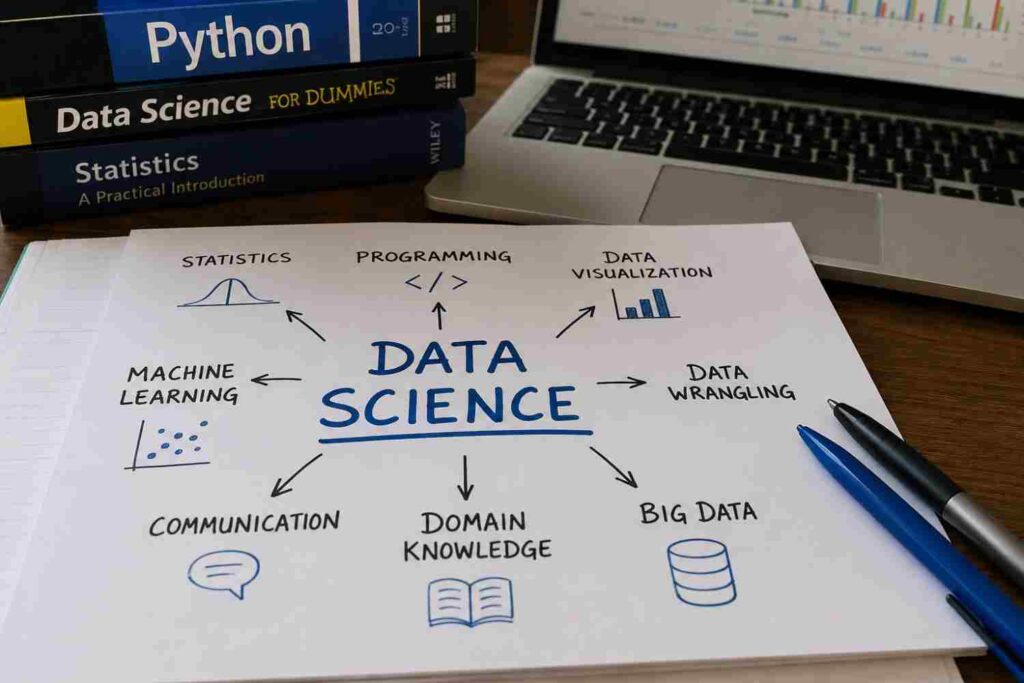
Data science is no longer just about building complex machine learning models. In 2026, employers need people who can turn messy data into useful decisions, explain results clearly, and work confidently with AI-powered tools.
The opportunity is strong, too. The U.S. Bureau of Labor Statistics projects 34% employment growth for data scientists from 2024 to 2034, much faster than the average for all occupations. Globally, the World Economic Forum also ranks AI and big data among the fastest-growing skill areas through 2030.
So, what should you actually learn?
Whether you are starting from scratch or already working with data, these 10 data science skills can help you build a stronger career in 2026.
1. Python Programming
Python remains one of the most useful programming languages for data science because it connects data analysis, visualization, automation, and machine learning in one ecosystem.
You do not need to become a software engineer before starting data science. However, you should be comfortable writing and understanding Python code.
Focus on:
- Variables, functions, loops, and conditional statements
- Lists, dictionaries, sets, and tuples
- Functions and modules
- Exception handling
- File and API handling
- Object-oriented programming basics
- Virtual environments and package management
You should also learn common data science libraries such as Pandas, NumPy, Matplotlib, and scikit-learn.
For example, imagine an online retailer has 500,000 transaction records. Python can help you remove duplicate orders, calculate customer spending, identify purchasing patterns, and prepare the dataset for a predictive model.
Microsoft’s data science learning materials similarly identify Python as a core tool for exploring, manipulating, and visualizing data.
How to practice Python
Do not spend months only watching tutorials. Build small projects.
Try creating:
- A sales-data cleaning script
- A personal expense analyzer
- A customer churn dataset explorer
- A simple automated report generator
The goal is to make Python a problem-solving tool rather than simply a language you can describe in an interview.
2. Statistics and Probability
Statistics is the foundation behind many data science decisions.
A model may produce a prediction, but statistics helps you Data Science determine whether that prediction is meaningful, how uncertain it is, and whether the evidence actually supports your conclusion.
Important concepts include:
- Mean, median, variance, and standard deviation
- Probability distributions
- Correlation and covariance
- Sampling
- Confidence intervals
- Hypothesis testing
- Statistical significance
- Regression
- Bayesian thinking
- Experimental design
Consider an e-commerce company testing a new checkout page. The new design increases the conversion rate from 4.1% to 4.4%.
That sounds positive, but a data scientist should not immediately declare victory. You need to ask whether the difference could have occurred because of normal random variation.
This is where statistical reasoning becomes more valuable than simply knowing how to run a Python function.
3. SQL and Database Skills
You can be excellent at machine learning and still struggle to perform basic Data Science work if you cannot retrieve information from a database.
SQL is therefore one of the most practical data science skills to learn in 2026.
At minimum, understand:
SELECTWHEREGROUP BYORDER BYJOIN- Aggregate functions
- Subqueries
- Common table expressions
- Window functions
- Basic database design
For example, a company might store customer information, orders, payments, and product data in separate tables.
A data scientist could use SQL to answer:
Which customers purchased more than three products in the last 90 days but have not purchased anything during the past 30 days?
That question may require several joins, filters, aggregations, and date calculations before Python is even used.
Learn to retrieve the right data first. Modeling comes later.
4. Data Cleaning and Preparation
Real-world data is rarely as neat as tutorial datasets.
You may encounter:
- Missing values
- Duplicate records
- Incorrect data types
- Inconsistent categories
- Outliers
- Typographical errors
- Different date formats
- Conflicting records
- Biased or incomplete samples
Data preparation is often where a large portion of practical data science work happens.
Suppose a customer dataset contains the following country labels:
- United States
- USA
- US
- U.S.
- United States of America
A computer may treat these as different categories even though they represent the same country.
A strong data scientist knows how to detect such problems and establish consistent rules for fixing them.
A useful data-cleaning workflow
Before modeling, ask:
- Where did the data come from?
- What does each column actually represent?
- How much data is missing?
- Are there duplicate observations?
- Are unusual values legitimate or errors?
- Could the data contain sampling bias?
- Can another person reproduce the cleaning process?
Good preparation can prevent an impressive-looking model from producing misleading results.
5. Data Visualization and Storytelling
Finding an interesting pattern is only half the job.
You also need to communicate that pattern to people who may not understand statistics, Python, or machine learning.
Data visualization helps turn thousands or millions of values into something people can interpret quickly.
Useful tools include:
- Tableau
- Power BI
- Matplotlib
- Seaborn
- Plotly
But learning software alone is not enough.
You also need to understand which visual works for which question.
For example:
- Use a line chart to show change over time.
- Use a bar chart to compare categories.
- Use a scatter plot to explore relationships.
- Use a histogram to examine distributions.
- Use a box plot to compare distributions and spot potential outliers.
Imagine a business leader asks why revenue fell last quarter. A dashboard with 20 unrelated charts creates confusion.
A better approach might show monthly revenue, product-category performance, customer segments, and the main drivers of the decline.
The strongest data scientists do not simply present data. They build a clear story around it.
6. Machine Learning
Machine learning is still an important part of modern data science, but you should learn it with a practical mindset.
Start with the fundamentals rather than jumping directly into complicated neural networks.
Understand:
- Supervised vs. unsupervised learning
- Regression
- Classification
- Clustering
- Feature engineering
- Training and test sets
- Cross-validation
- Overfitting and underfitting
- Model evaluation
- Hyperparameter tuning
For instance, a bank might want to predict whether a loan applicant is likely to default.
You could frame this as a classification problem. The model might use factors such as income, credit history, existing debt, and repayment history.
But building the model is only one step. You also need to evaluate its Data Science performance and consider the consequences of incorrect predictions.
Microsoft’s machine learning curriculum covers regression, classification, clustering, and deep learning alongside model training and evaluation.
Do not chase model complexity
A complicated model is not automatically a better model.
If a simpler model performs almost as well while being easier to explain and maintain, it may be the better business choice.
7. AI and Generative AI Literacy
In 2026, data scientists also need to understand how modern AI systems fit into their workflow.
The World Economic Forum identifies AI and big data as the fastest-growing skill category in its 2025–2030 outlook.
For a data scientist, AI literacy can include:
- Understanding large language models
- Working with AI-assisted coding tools
- Using APIs for AI applications
- Prompt design
- Embeddings and vector search
- Retrieval-augmented generation (RAG)
- Model evaluation
- Basic understanding of responsible AI
- Monitoring AI outputs for errors
For example, a data team could build an internal tool that allows employees to ask questions about company documents using natural language.
The data scientist may help prepare the underlying data, design evaluation tests, measure retrieval quality, and analyze whether the system gives reliable answers.
The important lesson is simple: learn how to use AI critically, not blindly.
An AI-generated answer can look convincing while still being incorrect.
8. Data Engineering and Cloud Fundamentals
You do not necessarily need to become a full-time data engineer, but understanding how data moves through modern systems will make you a much stronger data scientist.
Learn the basics of:
- APIs
- ETL and ELT pipelines
- Data warehouses
- Data lakes
- Batch vs. streaming data
- Cloud storage
- Basic distributed computing
- Data orchestration
Cloud platforms such as AWS, Microsoft Azure, and Google Cloud are widely used for modern data workloads.
Imagine your machine learning model works perfectly on your laptop. The company now wants it to process millions of new records every day.
Suddenly, questions about storage, pipelines, compute resources, monitoring, and deployment become important.
Understanding this broader workflow helps you collaborate with engineers and move projects from notebooks into production.
Microsoft describes the data science lifecycle as extending from business understanding and data acquisition through modeling, deployment, and customer acceptance.
9. Business and Domain Knowledge
Technical skills can help you build a model. Business knowledge helps you build the right model.
Suppose a retailer asks you to predict customer churn.
Before opening a notebook, you should understand what “churn” means for that particular business.
Does it mean:
- No purchase for 30 days?
- No subscription renewal?
- Cancellation of an account?
- A customer becoming inactive for six months?
Those definitions can completely change the dataset, target variable, and model.
Strong data scientists learn enough about the industry they work in to ask better questions.
Depending on your career path, useful domain knowledge could include:
- Finance
- Marketing
- Healthcare
- Retail
- Manufacturing
- Cybersecurity
- Logistics
- Energy
- Sports
You do not need to know everything about an industry. You need enough context to understand what the data represents and why the result matters.
10. Communication, Critical Thinking, and Problem Solving
This skill is often underestimated.
The World Economic Forum’s 2025 report lists analytical thinking among the most important core skills while also highlighting creative thinking, resilience, flexibility, and lifelong learning as increasingly important.
A data scientist might discover that customer cancellations increased by 12%.
That number alone is not useful.
A decision-maker needs to know:
- Why did cancellations increase?
- Which customer groups are affected?
- Is the pattern statistically meaningful?
- What evidence supports the explanation?
- What should the company do next?
- What are the risks of acting on the finding?
This requires critical thinking and communication.
Practice explaining your analysis
After completing a project, explain it in three versions:
One sentence: What did you discover?
One paragraph: Why does it matter?
Five minutes: How did you reach the conclusion?
If you can explain a technical analysis clearly without hiding behind jargon, you are developing a skill employers can actually use.
How to Prioritize Data Science Skills in 2026
You do not need to master all 10 skills simultaneously.
A practical learning order is:
Beginner stage
Start with:
- Python
- SQL
- Statistics
- Data cleaning
- Data visualization
Build several small projects before moving on.
Intermediate stage
Then add:
- Machine learning
- Cloud and data engineering fundamentals
- Business/domain knowledge
At this point, start working with larger and less-perfect datasets.
Advanced stage
Finally develop:
- AI and generative AI
- Communication, critical thinking, and production-oriented problem solving
The exact order can change depending on your target role. Someone pursuing a data analyst position may need more SQL and visualization early, while someone targeting machine learning engineering may need deeper programming, model development, and deployment skills.
What Should You Put in a Data Science Portfolio?
A strong portfolio should demonstrate how you think, not just prove that you can follow a tutorial.
Instead of creating five nearly identical machine learning projects, build projects that show different abilities.
For example:
- Business analysis: Analyze sales trends and recommend actions.
- SQL project: Explore customer transactions using complex queries.
- Machine learning project: Predict customer churn and evaluate several models.
- Visualization project: Build an interactive business dashboard.
- AI project: Create and evaluate a small AI-powered data application.
For every project, explain:
- The problem
- The dataset
- Your cleaning process
- Your methodology
- Key findings
- Model performance, if applicable
- Limitations
- Business recommendations
That makes the portfolio far more useful than a collection of screenshots and code files.
Common Mistakes When Learning Data Science
Many beginners slow their progress by focusing on the wrong things.
Avoid these mistakes:
- Learning dozens of libraries without understanding fundamentals
- Copying projects without understanding the code
- Ignoring SQL
- Treating machine learning as a magic prediction engine
- Using complicated models unnecessarily
- Skipping data cleaning
- Building dashboards without a clear question
- Focusing only on technical skills
- Using AI tools without checking their output
- Waiting until you “know everything” before building projects
Data science is too broad to master completely before you start applying it.
Build, analyze, make mistakes, and improve.
Is Data Science Still a Good Career Choice in 2026?
For people who enjoy analytical problem-solving, data science remains a strong career option.
The U.S. Bureau of Labor Statistics projects data scientist employment to grow from 245,900 jobs in 2024 to 328,300 by 2034, representing 34% growth.
The broader global picture is also encouraging. The World Economic Forum identifies big data and AI-related roles among the fastest-growing occupations and expects technological skills to rise rapidly in importance.
However, the career is changing.
Knowing Python and a few machine learning algorithms is no longer enough to stand out. Employers increasingly need people who can combine technical knowledge with business understanding, analytical reasoning, communication, and AI literacy.
That combination is where the real advantage lies.
Final Thoughts
The most valuable data science skills for 2026 are not simply a list of programming languages and machine learning algorithms. They form a complete problem-solving toolkit.
Learn Python so you can work with data. Learn SQL so you can retrieve it. Learn statistics so you can reason about it. Learn data cleaning so you can trust it. Use visualization to explain it, machine learning to model it, and AI to expand what you can build.
Then go one step further.
Learn how businesses actually use data, understand how modern data systems work, and practice communicating your findings to people who are not data scientists.
If you build those skills through real projects instead of passive courses, you will be far better prepared for the data science job market in 2026 and beyond.
FAQ
1. What skills do I need to become a data scientist in 2026?
The core skills include Python, SQL, statistics, data cleaning, visualization, machine learning, AI literacy, cloud and data engineering fundamentals, business knowledge, and communication.
2. Is Python enough to get a data science job?
No. Python is important, but employers typically need a broader combination of programming, statistics, data handling, machine learning, business understanding, and communication skills.
3. Should I learn SQL before machine learning?
For most beginners, yes. SQL teaches you how to retrieve and work with real business data. It is also highly practical for many data roles.
4. Do I need advanced mathematics for data science?
You need a solid understanding of statistics and probability, along with enough mathematics to understand the models you use. You do not need to master advanced mathematics before starting practical data science projects.
5. Will AI replace data scientists?
AI is likely to automate some data science tasks, but it also creates new workflows and opportunities. Data scientists who can combine AI tools with statistics, domain knowledge, critical thinking, and strong communication are better positioned to adapt as the field changes.

